About bonesthewebmaster

Artist, secular humanist. Contemporary oil paintings referencing renaissance methods. Style is allegoric/political, I take commissions for portraits.

Je Suis Humain – Nude and Möbius

Another painting concerning our common humanity, ‘Je suis humain’ is a French phrase implying ‘ that we are all one and should support one another. A female nude is embraced by the protection of a Möbius – effectively science as the protector of humankind rather than the deceitful hand of religion and all its double speak and bullshit. You work out the details for your self but science is supported by secular humanist values, whereas religious intolerance and dogma, often supports oppression, a little spoken of example being the catholic church’s support, for the Nazis during the 2nd. World War. You religionists can dress your Popes and your Imams in all manner of jewel bedecked cloth but your fairy tales become no more believable.

‘Je suis humain’ is a ‘shout out’ to all who reject fear and superstition and instead recognise our common humanity, the title is a call for justice for all. Who we are at our best, is represented in this painting by the beauty of womankind and all that womankind means to the nurturing and continued existence of our species. The female figure stripped of artifice, represents knowledge, the transcendent, freedom from the tyranny of ignorance and the super-natural, and the building of hope for our species.

So I start with a blank canvas, I bought the 130cm x 90 cm frame from Jackson Art and stretched a cotton canvas over it. I then sized it with rabbit skin glue, two coats for the front and one for the rear. I wanted a fairly smooth surface to enable the rendering of fine detail in the figure, this is achievable on canvas if you know how. My method is to use a primer, called ‘distemper’, I discovered it after reading the blog of the sadly murdered young artist Margaret Muller, I always think of her every time I use this primer and I am seriously grateful to her, as this primer is fantastic R.I.P. Margaret.

The distemper is made from water, oil, egg yolk and pigment, I apply several coats sanding between each to achieve a lovely silky smooth painting surface. I applied six coats for this painting. I then go about sealing the canvas and primer from the oil paint to follow. Firstly a light grey imprimatura, translucent  in this case is applied, followed by the toned ground for the painting, here it’s a mixture of burnt and raw umber and titanium white, applied thinly. I then complete an under drawing, putting in as much detail as necessary to help me finish the painting. I seal the ground and the under drawing by spraying on three coats of skimmed milk, using paper towels to wipe of the excess milk. The canvas is then ready to work up the paint layers.

As my method is to use C.S.O. paint, all layers are fat, this is another benefit of painting solvent free.
After the under drawing was completed and sealed, I experimented with different techniques of applying the turquoise paint to the canvas, sponges, knives and brushes, eventually settling on knives with some sparse brush work. Sometimes you just don’t know what is the best way to achieve a particular effect and it’s necessary to dive in and use your experience and imagination to find the solution. This a real problem for auto-didactic beginners but we’ve all been there, my advice is – don’t be afraid of making errors, just paint!

I wanted to preserve the form of the Möbius fairly accurately so I made the job easier by masking all around it.

the next stage will see the fundamentals of the Möbius in place.

Palette for the Möbius is : Rembrandt burnt senna, M.Harding phthalocyanine turquoise, Old-Holland, hookers green lake deep extra and some black and lead white.

Palette for figure : Blockx lead white, M. Harding lead tin yellow light, M. Harding venetian red, Daler Rowney ‘Georgian’ burnt umber, Daler Rowney ‘Georgian’ ultramarine, Winsor and Newton raw umber (green).

Continuing to build the painting via grisaille, it’s just a simple, elegant method for creating an accurate representation of the reality trying to be recreated on the support.

Further progress on 18.12.17, should have the painting finished by Xmas.

16.1.18

I’ve been unwell quite a lot so I haven’t made the progress on this painting that I intended to but – I have ordered a new camera, A Nikon, DSLR camera, so touch wood, once I get to grips with it, I’ll be able to post progress on this work, in some sort of decent quality.

13.2.18, so here’s the finished item, I haven’t had time to set up the camera properly but I think this photo is a reasonable representation of ‘je suis humain’. From a painter’s perspective, there are a few things I could have executed better but each painting presents different artistic and technical problems, that often need to be solved ‘on the fly’, so to speak. Overall, I’m fairly happy with the emotional content of the painting and its technical execution.

Share

re-nationalise!

As a life long socialist, this is great news to start my day.
article

Share

The End

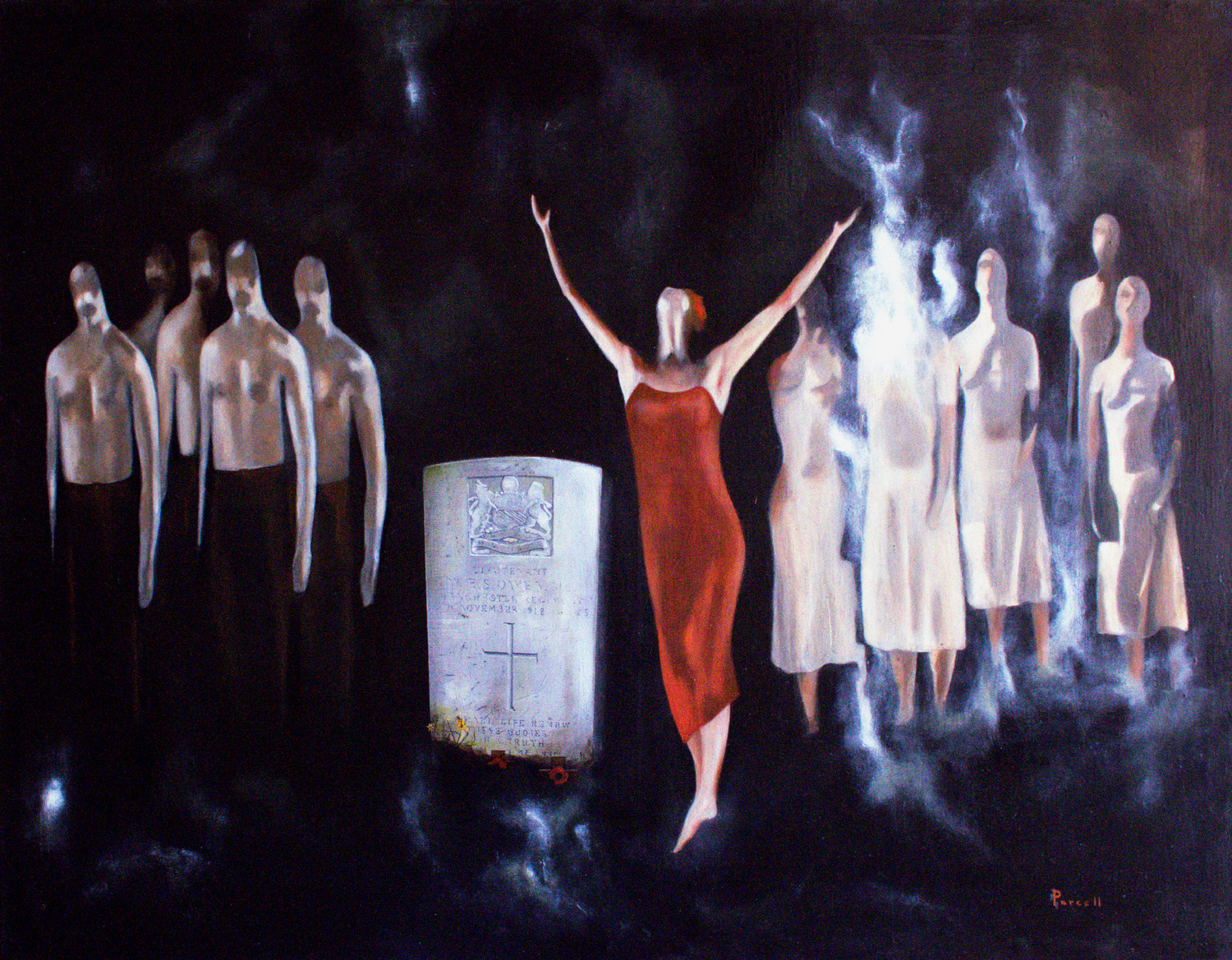
I’ve finally made a decision on which poem of Wilfred Owen’s to use as the inspiration for my third and last painting based on his poetry. ‘The End’ which is partially chiselled into his grave stone, will provide the combination of closeness that I feel towards him, (something that I want to make manifest) and also again realise the transcendent quality of the central panel of the Spring Offensive Triptych.
I came to this decision after reading an excellent article on the wilfredowen.org.uk website.

I was ill whilst painting ‘The End’ and really didn’t have the energy to chronicle the painting of it but here is the finished painting.

Share

Dunkirk 2017

Just watched this film, god that was hard to watch at times. Liked the music score too, interesting combination of an electronically modified orchestra and electronic effects. Elgar’s ‘Nimrod’ was added almost subliminally, clever stuff.

Share

What do endangered species represent?

As in secular life, religionists recognise no barriers when committing atrocities. Whether against our fellow man or against the animal kingdom we ‘protect’, there are no depths to which humankind won’t sink in its desire to satisfy its greed for wealth and power.

In this story

Tiger killing monk

a Thai monk in his search to find his god, trades in tiger parts to aid his transcendental journey. This is more than sad, that a monk, someone who is supposedly seeking a ‘oneness’ with the universe, defiles himself in such a destructive way. What really annoys me is that nature, the animals, our planet, doesn’t belong to anyone. For our own good we must preserve what we have here, otherwise our future will be less wonderful and possibly barren of many large mammals, creatures that bring us so many psychological and material benefits.

I’m happy for people to have personal gods, just stay the fuck out of secular life and support the protection of our planet!

Share

The Matthew Passion

Composed in 1727 Bach’s Passion is at the centre of his great religious works. Undoubtedly a Christian, Bach believed, as far as we can tell, that he was creating music that glorified his god. As an atheist I simply replace ‘religious’ with transcendent, thus apart from the sheer turgid nature of some of the text I can enjoy Bach’s wonderful music without the need to supplicate myself before a mythical super-natural monster. Some have argued that this music simply couldn’t exist without the religion it is pinned to, probably not as the text is at its core, but there are many examples of the transcendent in Bach’s instrumental music, without any such religious text being anywhere in sight, or earshot. Listen here Erbarme dich mein gott  for a truly amazing aria from The Matthew Passion, featuring the contralto Delphine Galou.

Share

special snowflakes

The paintings of Balthus can be thought provoking, particularly those, such as, ‘the guitar lesson’. As adults we can view such images and come to out own conclusions, we really don’t need a group of people who know what is best for us, to gain the upper hand. Thankfully as we can glean from reading the Huff’ Post article

Huff Post

the Metropolitan Museum of Art has ignored their whining and crying and continues to display the Balthus painting, as is their right.

I suppose the painting gives bored, rich people something to talk about, meanwhile artists get on with revealing the difficulties of life and the complexities of the human condition, no matter how unsettling to these ‘snowflakes’.

Share

Spring Offensive

The second realisation in oils of a series of paintings inspired by the poetry of Wilfred Owen. ‘Spring Offensive’ describes the awful moments of waiting for battle and then the horror of the blood sacrifice, as a regiment of young British soldiers of the 1st. world war, charged at their enemy.

Halted against the shade of a last hill,
They fed, and, lying easy, were at ease
And, finding comfortable chests and knees
Carelessly slept.
                               But many there stood still
To face the stark, blank sky beyond the ridge,
Knowing their feet had come to the end of the world.
Marvelling they stood, and watched the long grass swirled
By the May breeze, murmurous with wasp and midge,
For though the summer oozed into their veins
Like the injected drug for their bones’ pains,
Sharp on their souls hung the imminent line of grass,
Fearfully flashed the sky’s mysterious glass.
Hour after hour they ponder the warm field—
And the far valley behind, where the buttercups
Had blessed with gold their slow boots coming up,
Where even the little brambles would not yield,
But clutched and clung to them like sorrowing hands;
They breathe like trees unstirred.
Till like a cold gust thrilled the little word
At which each body and its soul begird
And tighten them for battle. No alarms
Of bugles, no high flags, no clamorous haste—
Only a lift and flare of eyes that faced
The sun, like a friend with whom their love is done.
O larger shone that smile against the sun,—
Mightier than his whose bounty these have spurned.
So, soon they topped the hill, and raced together
Over an open stretch of herb and heather
Exposed. And instantly the whole sky burned
With fury against them; and soft sudden cups
Opened in thousands for their blood; and the green slopes
Chasmed and steepened sheer to infinite space.
Of them who running on that last high place
Leapt to swift unseen bullets, or went up
On the hot blast and fury of hell’s upsurge,
Or plunged and fell away past this world’s verge,
Some say God caught them even before they fell.
But what say such as from existence’ brink
Ventured but drave too swift to sink.
The few who rushed in the body to enter hell,
And there out-fiending all its fiends and flames
With superhuman inhumanities,
Long-famous glories, immemorial shames—
And crawling slowly back, have by degrees
Regained cool peaceful air in wonder—
Why speak they not of comrades that went under?
Reading the poem as a 12 year old for the first time made a deep, lasting impression on me, perhaps because I’m English and realising that if I had been born into a different time, it could have been me. The words are leaden, I find nothing uplifting in them, they are a stark warning to those who might love life.

Those young men were conned into believing that they were serving their country, in fact they were disposable, their deaths serving only to settle disputes between the corrupt monarchies and politicians of the day, (nothing much has changed).

This painting is my second triptych, this time on hinged wooden support panels, onto which I glued, aluminium painting panels, the outer panels are hinged to fully close, so two paintings in all, the closed front panels showing a seated Wilfred Owen, in his Captain’s uniform. The abbreviated letters of the title of the poem painted in blood red and asking a question ‘SO?’, what now, what have you done, why the vile carnage? Not though, ‘So What’, their sacrifice meant nothing.

The panels once opened, reveal the poem to the right and left and in between them, the central panel with its scene of battle and the hands (my hands) open to receive the fallen, remembering and immortalising their sacrifice – for us. These images are photoshop ‘cartoons’ and are used as my guide to realise the idea finally in oils.
So to technical matters –  here’s the aluminium panel fixed to its marine ply support panel, I was excited to paint on this material, it is a relatively new thing for these panels be commercially available and affordable. I believe that this material maybe the future of panel painting, it is easy to work with and once prepared the painting surface is super smooth. I’m going to prime with two coats of lead white, with a touch of chalk and sun thickened linseed oil, this will provide a little tooth and aid drying, very important for the first few layers. The panels are available from here

8.11.17 –  I’ve been making steady, calm progress on this triptych, realising Wilfred Owen’s seated portrait in oil from the poor photos that exist of him is proving difficult, however I think that I’ve managed to get his expression and the rest is now falling into place. Some work to do on the shadows and values generally. I’m considering ‘sepia toning’ the finished item with a thin glaze of burnt umber to mimic a period photo. If so  I’d do the same for the inner central painting

The central panel is going to take a lot of work to bring to completion, once I’m happy with the achromatic grisaille (under painting in grey values) I’ll start to add transparent red paint to the heart, the hands and the poppies. Colours will include Venetian red, vermilion, cadmium red, alazarin crimson, burnt sienna burnt, and raw umber, vandyke brown, yellow ochre, ivory black and of course my favourite paint, lead white. Anyway here’s progress as of 9.11.17.

The following photo shows the extra pieces needed to realise the triptych’s support, the hinges, the beading that surrounds and protects the panel’s edges and of course the poem ‘Spring Offensive’ printed on canvas, at a local printers and glued to the marine ply panels using rabbit skin glue.


Some further progress 14.12.17 on the grisaille for the centre panel before I add the first transparent reds to the heart, the poppies and the hands.

Progress as of 10.2.18, the two outer panels are looking more like the finished thing as I add further transparent coats of paint, invent a few new details and refine established ones.

progress on the centre panel, 12.2.18 All day I’ve been adding to the hands, velaturas of Venice red, lead white, antimony, yellow ochre and a few complimentary colours. My new Nikon camera is helping represent the paintings much better.

Further progress on the centre panel, 28.2.18 I’ve added some veins to the heart and continued to glaze the hands, I’ll add more details to them next and I’ve integrated the heart more into the background with some soft cloud detail on the left of the heart. I’m also thinking of ideas for my final painting in this Wilfred Owen trilogy, I want more red, ghostly figures, the canal at Ors and perhaps his gravestone. I intend to visit that place one day, if you read the story of the battle and imagine that you have been commanded to cross the canal under heavy fire, you realise the madness and the ‘badness’ of war in an instant and also the ‘pity’ which Wilfred Owen was so keen to express.

Almost simultaneously I’ve been steadily adding details to the two outer panels, the red of the poems initials, painted in cadmium red with a little burnt sienna. The the fine coats of translucent cad’ red are faintly illuminated from the rear painted in white, then light pink. Details like this are the difference between a good painting and one that really ‘pops’.
The background scene further envelops Wilfred Owen as he sits there in his rather tatty uniform. I’m painting him from old photos, found in books and on the internet, none of which are in a good state of repair, so some invention is called for and of course, artistic licence.
After the whole is complete I’m considering an overall glaze of burnt umber to give a sepia effect, the sort found in old photos.

The painting finished and the beads attached.

I’m very excited by how this all looks now, below is a photo of the opened inner panels mounted on the wall. I’m very happy with how the text printed, the material is a contemporary canvas material that was stuck to the wooden panels with R.S.G.

Share

Vanitas_August 17

I was thinking of a particularly arrogant American ex-friend when I painted this, someone who claimed to be liberal but was in fact a believer in American exceptionalism without even realising it.

Vanitas is an old form (in simple terms) of expressing the paradox of life and death. There are many great Vanitas painters but I think the main source of inspiration for this particular painting was Pieter Claesz, he was a Dutch painter working in the 17th cent.

I’m looking into getting a better camera, as once again I have to apologise for the shameful photo.

Share

Craig – William Lane and his white noise

William Lane Craig disables comments on his youtube videos but I can comment on his sanctimonious, holier-than-thou, word salad right here. Firstly, of many current theologians, this mono-toned bore is top of the pile of turds that represent the lies and harmful dogma of most religious cultists. His tone is that of a hectoring elderly witch, trying to convince her incredulous pupils to boil another bat. This a man/bot who is avoided by other debaters in the field of philosophy and and truth seeking. Lawrence Krauss realises that he made a big mistake in debating the windbag and Dawkins refuses to debate him on the grounds that he emits a droning, pompous white noise which Craig presents as ‘logic’.

In another youtube video he makes his ‘case’ against humanists, referring to them as cultists and accusing them of representing only the human species. He is not a stupid man but he is very capable of presenting misleading and skewed arguments. The truth about the humanists is that they look out for the welfare of all the inhabitants of planet earth, the animals and humans co-exist in harmony. He is lying again to deliberately paint humanists as morally inferior to his bible based ‘morality’. And that morality is so good for mankind isn’t it? Just look at the mess it has created. Hardly a page of that book goes by without, slaughter, enslavement, rape, genocide and the like getting the nod. Such a high moral bar the bible!

On the moral behaviour of humanists and indeed anybody who doesn’t use the Goat Herder’s Guide to the Galaxy as their source, he rejects the idea that they are capable of truly moral behaviour. The fact that there is massive evidence to the contrary, in societies all over the world is irrelevant to him, this man’s stiff delivery doesn’t help his cause one bit. All those years poring over philosophical and theological tombs have stultified what might have been a clever man. The weight of those religious texts and the anvil that must be carried according to him, (commonly known as the bible), obscures from his sight the morality developed from the simple phrase ‘do unto others as you would have done unto you’. It’s known as the golden rule and existed way before the bible and the Qur’an etc. Although Christians would claim the phrase for their prophet Jesus, it is already clearly in use well before Jesus, if he ever existed.

“Never impose on others what you would not choose for yourself.”
—Confucius, Analects XV.24 (ca. 500 B.C.)

To follow the golden rule requires no god, just common human empathy, brotherhood, the desire to live in peace and live justly. The use of simple common sense and reason to see that we are better of living in harmony than waging war. Craig’s God is an ugly burden that has clearly corrupted his mind, hopefully his droning noise will soon be over, when he realises his attempts to pollute the minds of men are frustrated by the internet. A place where a massive burden of proof is required to prove fairy-tales.

Finally, the most annoying thing to all non believers about this man has to be the constant personal attacks on our morality, the massive arrogance he displays, in assuming moral superiority is both sickening and annoying, his decades of learning have taught him little about true morality, some original thought instead of pouring over ancient, irrelevant texts might help him think more clearly.

Share